Genealogical research is one of the most popular uses of the internet. We do it because deep down we want to know something about how and where we belong.
Being a Twisleton is easier than being a Brown or a Smith when it comes to trawling through the volumes at the Family Record Centre (FRC). The name is an advantage here. Its frequent misspellings are a balancing debit. With an E mail address like john@twisleton.co.uk you can be sure I miss out on electronic mail since no two people copy Twisleton the same.
Genealogy is a science of names and dates - a jigsaw puzzle with so many pieces missing you wonder at genealogists’ persistence. Since the puzzle has you yourself and those dear to you as the pieces, you keep trying. Here are some ideas to help you find the missing pieces.
Learn about your surname
Surnames have different origins, but many names tell a story about the way the land lies. Twisleton, for instance, is such a name. The word means a settlement (old English: ‘tun’) on either a fork in a river (‘twisla’) or a boundary (Scandinavian: ‘twistle’).
There is no settlement surviving called Twisleton but a quick browse of the name on the internet demonstrates its association to this day with so-called Twisleton Scars. These are part of the descent towards Ingleton from Whernside, the highest of the Three Peaks in the Yorkshire Dales. There alongside Twisleton Scars lie Twisleton Lane, the former Twisleton Hall and the nearby River Twiss, most probably named by association with the historic community of Twisleton rather than vice versa. One other claimant to the Twisleton homeland is Twiston, possibly abbreviated from Twisleton, a few miles on the other side of the Lancashire border near Blackburn.
The West Riding Victoria County History mentions William of Twyselton holding lands near Ingleborough in 1316. This takes my association with Craven North Yorkshire back over 25 generations to the troublesome reign of King Edward II when the inhabitants of Twyselton saw the Scots descend upon them.
Helpful sources
I can trace my family’s lineage over 700 years in the same part of Yorkshire, but the hard evidence of continuity goes back only less than 250 years. A search at the FRC took me back to my two-times great-grandfather Thomas Twisleton of Stainforth (1777-1841). Parish church records took me back with certainty another two generations to my four-times great-grandfather, Robert Twisleton of Horton who died in 1766.
Giggleswick, Horton and Clapham parish records show Twisletons in Craven right back to their commencement around 1560. Wills and rentals, too, show the Twisletons have been a force in that land for seven centuries or more.
Properties give further evidence concerning the Twisletons of Craven. Sherwoodhouse on the brow between Stainforth and Horton has RAT 1703 inscribed over the front door, almost certainly referring to Robert and Alice Twisleton whose marriage ‘sexdecimo die Maii 1694’ is recorded in Giggleswick church registers. Thomas Brayshaw’s history of Giggleswick speaks of Twisletons living there before 1600. The 17th Century Twisleton Hall outside Ingleton, now a farmhouse, has a name more associated with the historic naming of the land than any of my known forbears.
Twisleton’s Yard in Settle is listed as being built around 1832 for a James Twisleton and Twisleton residence there is confirmed in census records.
Colourful ancestors
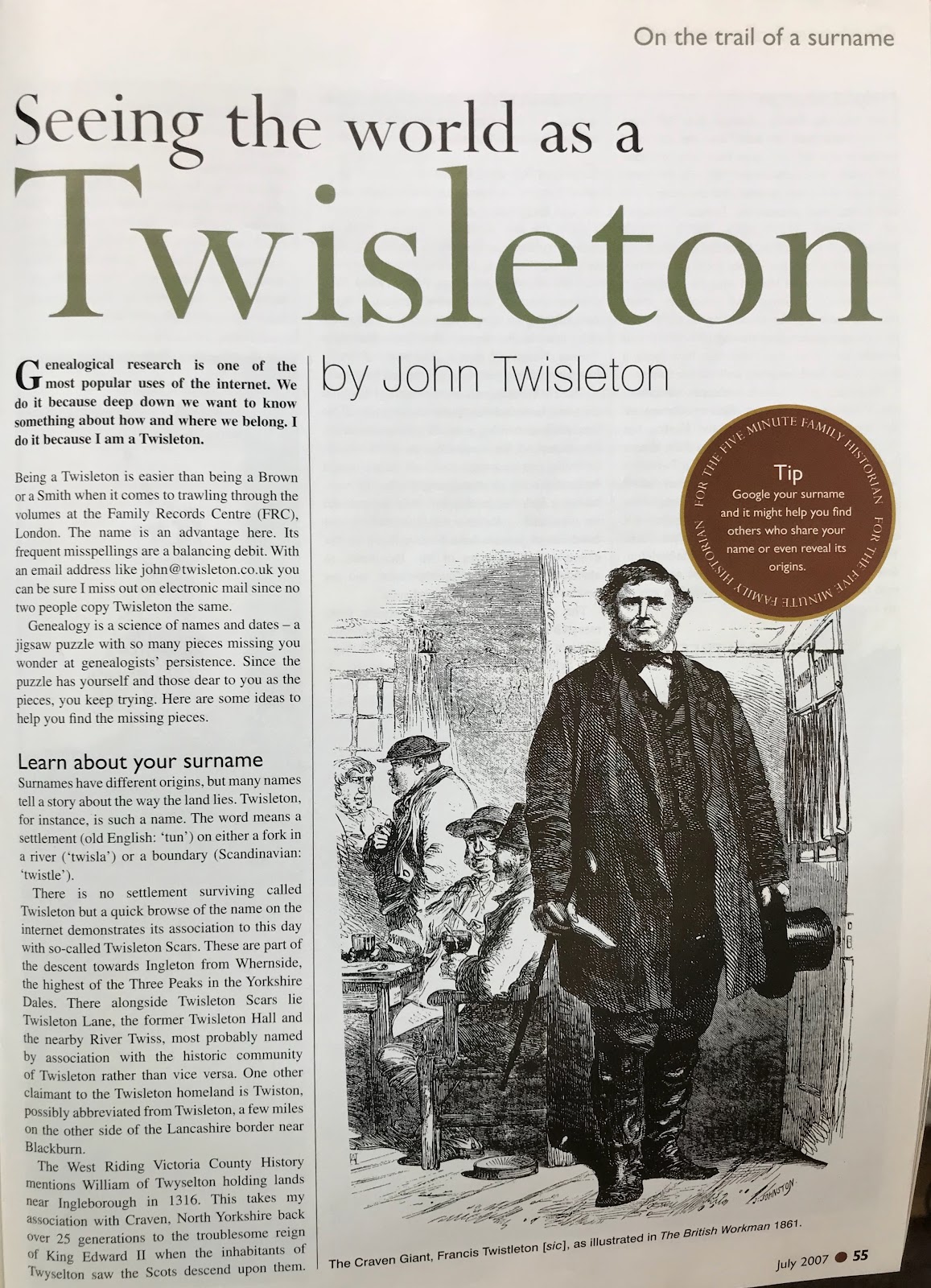
What is it that lures people into hours of research through long boring lists of names and places? I recall the first stirrings of interest when my father explained something in the family deed box. It was a cutting from The British Workman of 1861 showing what my father called ‘The Craven Giant’, a sketch of an imposing figure campaigning for temperance in a pub captioned: ‘Mr. Francis Twistleton, The Giant Yorkshire Farmer (Weighs 22 stone)’. The study of family history suddenly got some colour and purpose.
The 1861 cutting about my forbear inspired me – and humbled me: “In the earlier years of his life, when a working man, he was accustomed, like many of his comrades, to drink freely, believing that hard work could not be performed without the aid of stimulating drinks. He was, however, induced to abandon both the pot and the pipe, and … We have reason to believe that hundreds of persons have been induced by the example and entreaties of Mr. Twistleton, to abandon their habits of intemperance, and are now sober fathers, and good husbands.”
The article contrasts with a vignette from research into the southern branch of the family. William Fiennes (1798-1847) 15th Lord Saye and Sele cuts a rather less devout profile. A friend of the Prince Regent, he seems to have shared the hedonistic attitude of the Regent’s Court. One day he left this message for his valet: “Put six bottles of port by my bedside and call me the day after tomorrow”!
Back to earth
Genealogical study can bring you brief splashes of celebrity but more often there is a humble charting of lives summarised by family relationships and occupations gleaned from census forms and parish registers. For the Twisletons of Craven, records from 1560 to date chart livelihoods made initially from the land that developed over the last two centuries with industrialisation.
Genealogy is a puzzle which can be both stimulating and frustrating. My own experience so far on the Twisleton tale has put me in touch with my rural roots and their evolution, and encouraged me to learn about the lie of the land that brought about my name. Through my family history I’ve identified ancestors in records stretching back hundreds of years, engaged with another famous family group and seen vignettes from the past of the courage, humanity and, yes, indulgence of my forbears. I will persist with the puzzle and the connecting – this is the game of the genealogist!
Twisleton Tree
Thomas Twisleton (1777-1841) Farmer – Nanny Twisleton (Batty) (c1784-1858)
Children include:
Francis Twisleton (c1813-1875) Farmer and “Craven Giant” – Mary Twisleton (Herd) (c1797-1887)
and Gregory Twisleton (c1825-1875) Labourer – Jemima Twisleton (Charnley)
Children of Gregory & Jemima Twisleton include:
Gregory Twisleton (1863-1937) Grocer – Jane Twisleton (Holmes) (1870-1947)
Children of Gregory & Jane Twisleton include:
Gregory Francis Twisleton (1900-1974) Bank manager – Elsie Twisleton (Vickers) (1922-) Teacher
Children of Gregory & Elsie Twisleton include:
John Fiennes Twisleton (1948-) Anglican priest and author
Thomas Twisleton (1777-1841) Farmer – Nanny Twisleton (Batty) (c1784-1858)
Children include:
Francis Twisleton (c1813-1875) Farmer and “Craven Giant” – Mary Twisleton (Herd) (c1797-1887)
and Gregory Twisleton (c1825-1875) Labourer – Jemima Twisleton (Charnley)
Children of Gregory & Jemima Twisleton include:
Gregory Twisleton (1863-1937) Grocer – Jane Twisleton (Holmes) (1870-1947)
Children of Gregory & Jane Twisleton include:
Gregory Francis Twisleton (1900-1974) Bank manager – Elsie Twisleton (Vickers) (1922-) Teacher
Children of Gregory & Elsie Twisleton include:
John Fiennes Twisleton (1948-) Anglican priest and author
Further reading
A History of the Ancient Parish of Giggleswick by Thomas Brayshaw & Ralph M. Robinson (Halton & Company, 1932)
The Owner of Broughton Castle in 1729 by David Fiennes (Banbury Historical Society Autumn 1970)
Stainforth – Stepping Stones through History (Stainforth History Group 2001)